
Programmes
Selected International Programmes
Programmes within my regional portfolio at Laxton Group. Each case separates my commercial responsibility from the wider programme, and contains no commercially sensitive detail.
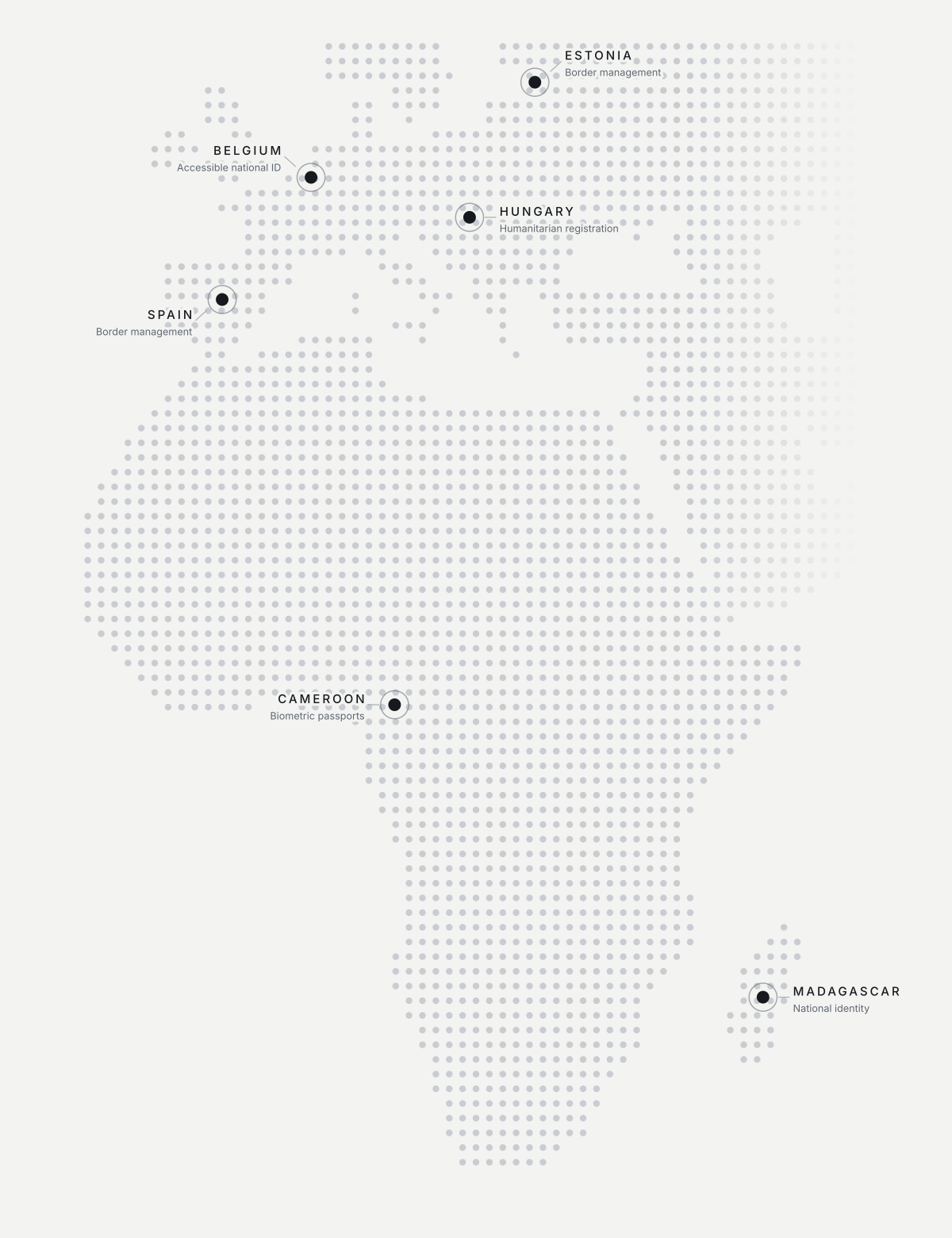
Where the work takes place
Six countries, two continents.
From national identity in Madagascar to border management in Spain and Estonia, each programme answers a different public need.
Madagascar
National Identity
- Country
- Madagascar
- Sector
- National identity
- Solution
- Biometric enrolment infrastructure
- Year
- PRODIGY programme, supported by the World Bank
Context
Madagascar is bringing 33.5 million people, spread across remote communes and mountainous terrain, into a single secure identity record for the first time. Until now identification relied on paper civil registers, records conflicted between offices and there was no unified database to detect duplicates or reach underserved regions.
Commercial and strategic responsibility
I led Laxton's commercial engagement for the programme, from institutional discussions and solution positioning through negotiation and contracting. The aggregate contract value exceeds US$35M including extensions. Field delivery was carried out by Laxton's delivery teams together with programme partners.
Approach
The plan had to hold up in field conditions: remote communes, mountainous terrain, limited infrastructure and severe weather, including cyclone season. Commercial, technical and delivery colleagues worked closely with the government and programme partners, including through periods of political uncertainty.
Programme outcome
The national pilot enrolled 129,613 citizens across 116 centres with 100% data completeness. The mass rollout launched on schedule despite political instability and cyclones.
A legal identity opens access to public services, financial inclusion and civic participation. For me, the measure of this programme is whether it reaches the people who have always been left outside formal systems.
Evidence
Outcomes describe the programme as a whole, as published by Laxton, not my individual achievement. Read the Laxton case study on Madagascar (opens in a new tab)
Cameroon
Biometric Passports
- Country
- Cameroon
- Sector
- Passports and travel documents
- Solution
- Biometric registration kits, including diplomatic missions
- Year
- 2021
Context
Cameroon's General Delegation for National Security set out to cut passport issuance from months to 48 hours, under a ten-year programme with Augentic and Imprensa Nacional-Casa da Moeda. The equipment had to serve citizens at home and abroad on a common standard, and it had to arrive on schedule.
Commercial and strategic responsibility
I contributed to the commercial side of Laxton's supply of biometric registration kits, including the configuration for embassies and consulates. The national passport programme itself is led by the Cameroonian authorities and their prime contractors.
Approach
Meeting the timeline meant planning alternatives early and drawing on Laxton's global logistics network, so that equipment at home and abroad would work to one common standard.
Programme outcome
163 registration kits delivered, 38 of them to diplomatic missions, enabling nationwide passport issuance within 48 hours.
Faster and more secure passport issuance strengthens document integrity and shortens the wait for a travel document, wherever a citizen applies.
Evidence
Outcomes describe the programme as a whole, as published by Laxton, not my individual achievement. Read the Laxton case study on Cameroon (opens in a new tab)
Hungary
Humanitarian Biometric Registration
- Country
- Hungary
- Sector
- Humanitarian registration
- Solution
- Mobile biometric capture and document verification
- Year
- 2023
Context
During the war in Ukraine, Hungary faced a sudden and very large arrival of people seeking safety. The Hungarian Police needed to register and verify individuals quickly and reliably at entry and exit points, under time pressure and with humanitarian sensitivity.
Commercial and strategic responsibility
This work sat within my regional portfolio, where I supported the commercial relationship. Deployment was carried out by Laxton's delivery team with the Hungarian Police.
Approach
Laxton deployed Chameleon 5R devices with the Hungarian Police to capture facial images and fingerprints and to verify identity documents. The priority was speed of deployment and ease of use for officers in the field.
Programme outcome
Biometric capture and document verification deployed at entry and exit points with the Hungarian Police in 2023.
Reliable identification supports orderly and dignified processing for people in a vulnerable situation, and helps authorities direct protection and services to the right individuals.
Evidence
Outcomes describe the programme as a whole, as published by Laxton, not my individual achievement. Read the Laxton case study on Hungary (opens in a new tab)
Belgium
Accessible National Identity
- Country
- Belgium
- Sector
- National identity
- Solution
- Portable eID enrolment
- Year
- 2024
Context
Belgium was among the first countries to deploy an electronic identity card at full scale, with the aim of equal access to digital services for every citizen. Elderly residents of care homes, many with limited mobility, struggled to reach registration centres and risked being left behind.
Commercial and strategic responsibility
Belgium sits within my European portfolio, and I supported the commercial engagement for this solution. The national eID programme is run by the Belgian authorities; Laxton's contribution is the portable enrolment service.
Approach
Laxton introduced a portable enrolment solution that brings the identity service to the residents, so that eID cards can be issued without anyone having to leave their care facility.
Programme outcome
Portable enrolment for care home residents, supporting the national objective of 100% eID adoption.
Accessible enrolment means older citizens with limited mobility keep full access to public services, without travelling to a registration centre.
Evidence
Outcomes describe the programme as a whole, as published by Laxton, not my individual achievement. Read the Laxton case study on Belgium (opens in a new tab)
Spain
Entry/Exit System Pilot
- Country
- Spain
- Sector
- Border management
- Solution
- Biometric capture and document verification for EES
- Year
- 2020, EU Entry/Exit System
Context
The EU Entry/Exit System, part of the Smart Borders package, registers the entry, exit and biometric data of non-EU nationals at external borders. Before a Europe-wide rollout, authorities needed evidence of how the processes would work at busy land crossings.
Commercial and strategic responsibility
I supported Laxton's commercial engagement for the pilot within my regional portfolio. The pilot itself was led by Frontex and the Spanish authorities.
Approach
Laxton supported the Frontex Research and Innovation Unit in piloting EES processes at Spanish land borders, testing biometric capture and document verification in live operation.
Programme outcome
97% traveller verification across 29,020 transactions in the Frontex pilot.
Dependable border technology keeps crossings secure and efficient for travellers and officers, and gives policy makers evidence from real operating conditions.
Evidence
Outcomes describe the programme as a whole, as published by Laxton, not my individual achievement. Read the Laxton case study on Spain (opens in a new tab)
Estonia
Border Management
- Country
- Estonia
- Sector
- Border management
- Solution
- Mobile biometric devices for rail crossings
- Year
- EU Entry/Exit System
Context
Estonia was among the first Member States to prepare for the EU Entry/Exit System. Many travellers cross its external border by train, so officers need to register passengers on the move, with high traffic volumes and in all weather conditions.
Commercial and strategic responsibility
Estonia sits within my regional portfolio, where I supported Laxton's commercial engagement. Device testing and deployment were carried out with the Estonian authorities and Laxton's technical teams.
Approach
Laxton's mobile biometric devices were piloted in Estonia and refined during live use, so that officers could capture biometrics and verify documents at rail crossings.
Programme outcome
Laxton mobile devices selected for EES registration at rail border crossings after extreme weather testing.
Mobile registration keeps rail crossings moving while meeting new EU border requirements, for travellers and officers alike.
Evidence
Outcomes describe the programme as a whole, as published by Laxton, not my individual achievement. Read the Laxton case study on Estonia (opens in a new tab)